Best Crypto Prop Trading Firms 2026: How to Choose
7 minutes

Crypto proprietary trading firms provide funded accounts to traders in exchange for a share of their profits, giving traders access to greater capital without risking their own funds. As the category has grown, so has the number of firms offering crypto-focused challenges — each with its own pricing structure, evaluation rules, and payout terms.
This guide compares four firms traders frequently consider — AceTrader, FTMO, Propr, and Breakout — based on what each firm publishes about pricing, account rules, and payouts, to help you evaluate which structure best fits your trading style.
Key Factors to Compare
The headline profit-split number tends to get the most attention, but it's only one part of the picture. A few other factors are just as important when evaluating a firm:
Entry cost vs. Account size — how much you pay upfront relative to the capital you'll be trading with
Evaluation rules — profit targets, drawdown limits, minimum trading days, and any consistency requirements that apply to a passing account
Payout speed and minimums — how quickly a firm processes payouts, and the smallest amount you're able to withdraw
Instant funding — whether you can skip the evaluation entirely for a flat fee
Transparency — whether a firm publishes verifiable payout data, or relies mainly on testimonials
Pricing & Funding Overview
Firm | Entry Cost | Fund Size Range | Profit Split |
|---|---|---|---|
AceTrader | From $9 | $1,000 – $20,000 | Up to 90% |
FTMO | From €79 | $10,000 – $200,000 | Up to 90% |
Propr | From $25 | $5,000 – $100,000 | 80% |
Breakout | From $20 | $5,000 – $200,000 | Up to 90% |
Figures reflect each firm's public terms as of mid-2026 — always confirm current pricing and rules directly before purchasing. Crypto-native status and payout-data transparency are covered in each firm's profile below.
Risk & Leverage Snapshot
Drawdown rules and leverage limits are the parameters most likely to end an evaluation or a funded account, so they're worth comparing directly.
Firm | Daily Loss Limit | Max Drawdown | Max Leverage |
|---|---|---|---|
AceTrader | None | 6 – 10% (by plan) | Up to 40x |
FTMO | 5% | 10% | Up to 3.3x |
Propr | 3% (1-Step) / 5% (2-Step) | 3 - 6% (by plan) | Up to 10x |
Breakout | 3–5% (by tier) | 3 –8% (by plan) | Up to 5x |
AceTrader is the only firm in this comparison without a daily loss limit — only a maximum drawdown applies, which gives traders full flexibility over intraday sizing without a hard cap on any single session's loss.
Maximum leverage varies by instrument and pair at every firm listed — the figures above reflect each firm's stated ceiling on major pairs. Always check the specific instrument's leverage on each firm's platform before sizing a position.
Firm-by-Firm Breakdown
AceTrader
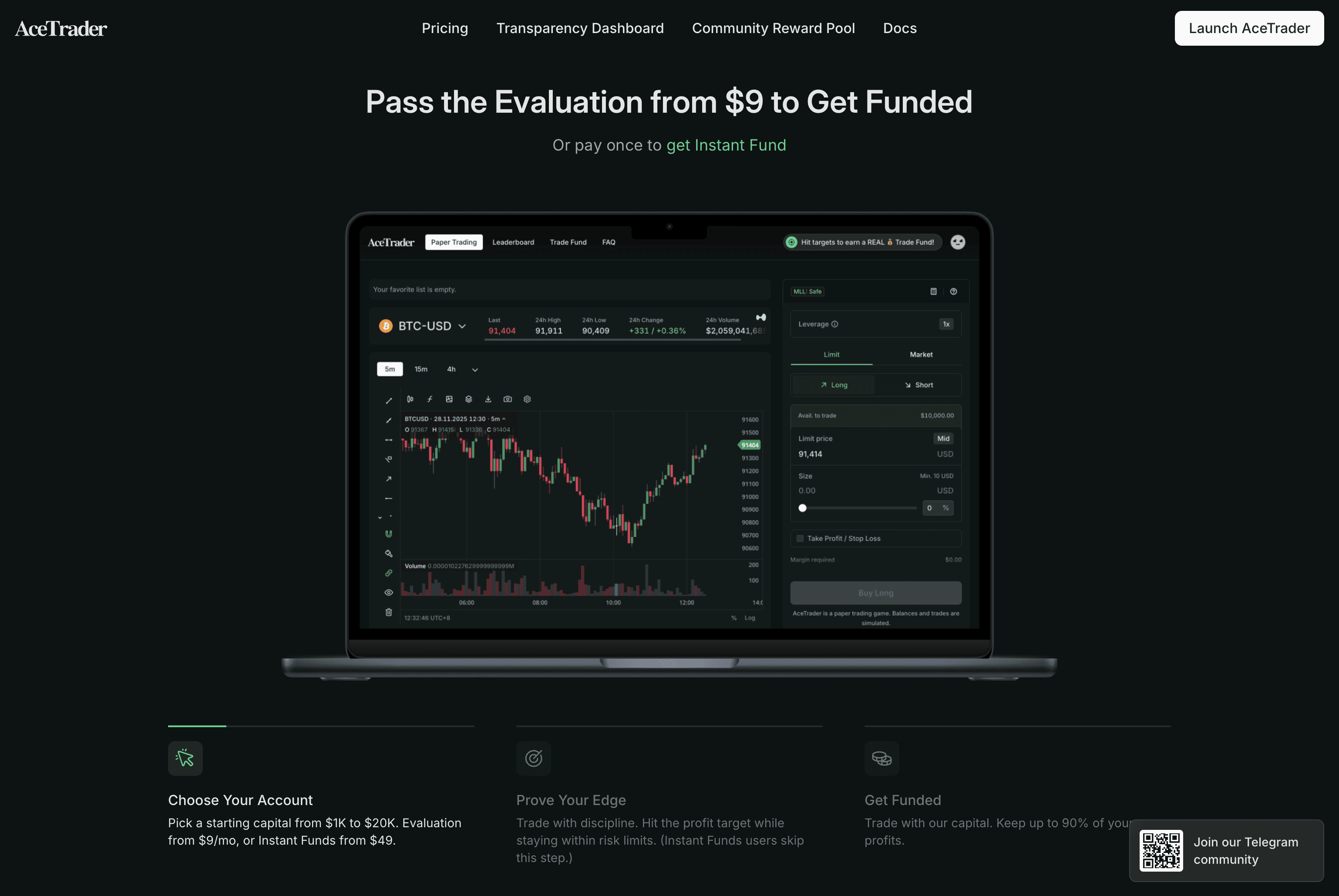
Built by 9GAG — a backing that brings an established audience of 200M+ and a track record of shipping products
Lowest entry point on this list — evaluations from $9/month, Instant Fund from $49
Instant Fund option available from $49 — a one-time payment that skips the evaluation entirely and moves straight to a funded account
Execution powered by Hyperliquid, reflecting live on-chain market conditions
No Daily loss limit — only a fixed maximum drawdown applies, giving traders full control over intraday position sizing without a hard daily cap
A public transparency dashboard listing individual payouts with block-explorer links, allowing traders to verify results independently
Trade-off: a comparatively newer firm with a shorter operating history than some of the more established names — worth confirming current evaluation terms on the pricing page before starting
Best for: traders who want the lowest cost of entry, the option to move directly into Instant Fund, and independently verifiable proof of payouts.
FTMO

The longest-established firm on this list (founded 2015), offering accounts from $10,000 up to $200,000 and support in 20+ languages
Two challenge types: 1-Step and 2-Step, with entry fees from €79 ($10,000 account, 1-Step) up to €1,080 ($200,000 account, 2-Step)
Supports crypto deposits and payouts
Trade-off: crypto is one instrument class alongside forex, indices, and stocks, rather than the firm's primary focus, and there is no instant-funding option
Best for: traders who value a large, established multi-asset firm and see crypto as one part of a broader trading strategy.
Propr
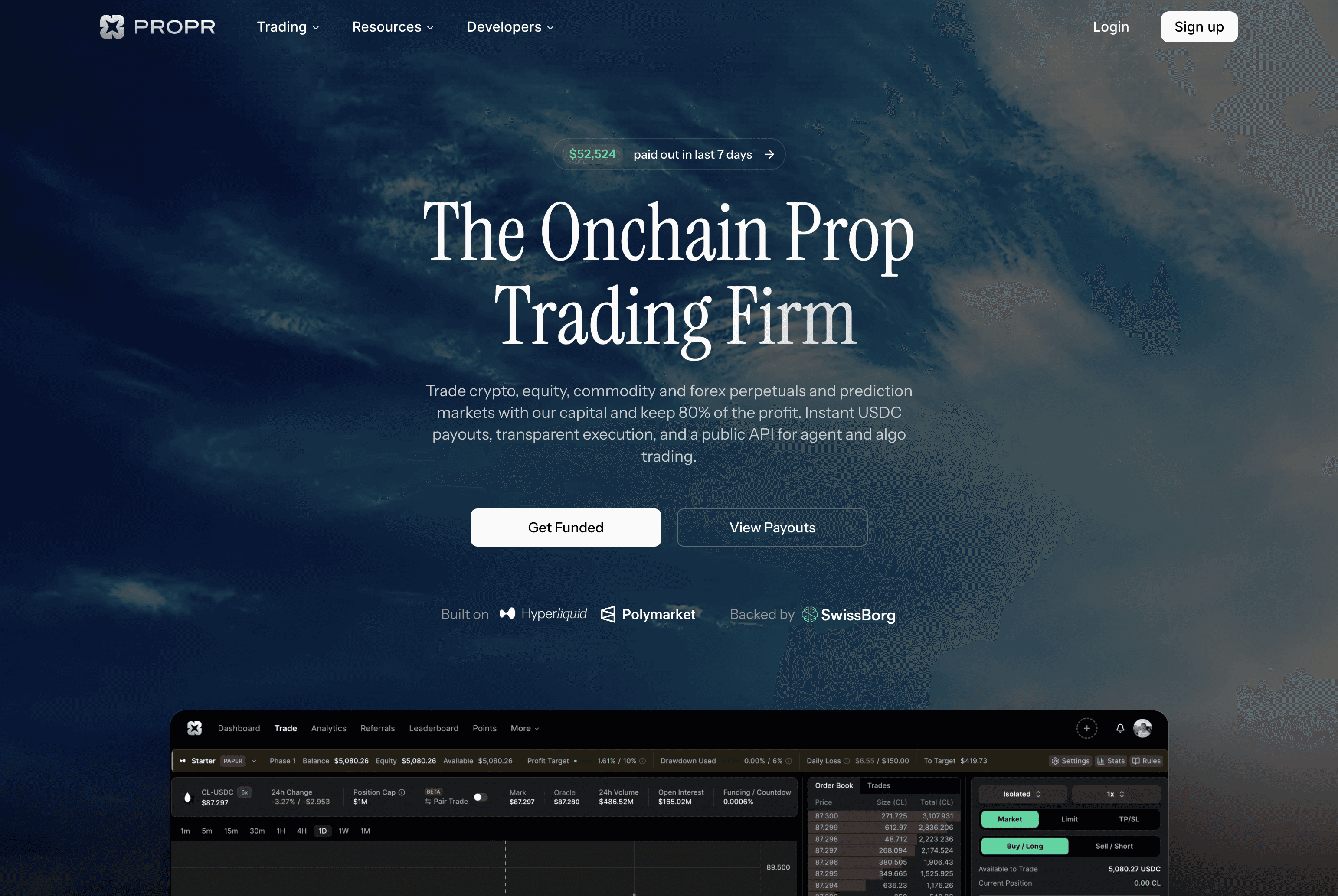
Three challenge types: Classic 1-Step, Classic 2-Step, and Turbo — with entry fees from $25 ($5,000 account, Turbo) up to $60 ($5,000 account, Classic 1-Step), all at an 80% profit split
Turbo pairs a tighter drawdown (3% static) with a lower fee; Classic 2-Step offers a more relaxed drawdown (8% trailing) at a mid-range fee
No time limit or minimum trading days on any tier — only daily loss and drawdown caps apply
Fast on-chain USDC payouts (avg. ~5 hours), supported by a public transparency page
Trade-off: not available to traders in the US, UK, or Russia; comparing three challenge types requires a bit more upfront research than a single-tier structure
Best for: traders who prefer choosing a specific risk-and-fee combination rather than a single standard challenge.
Breakout
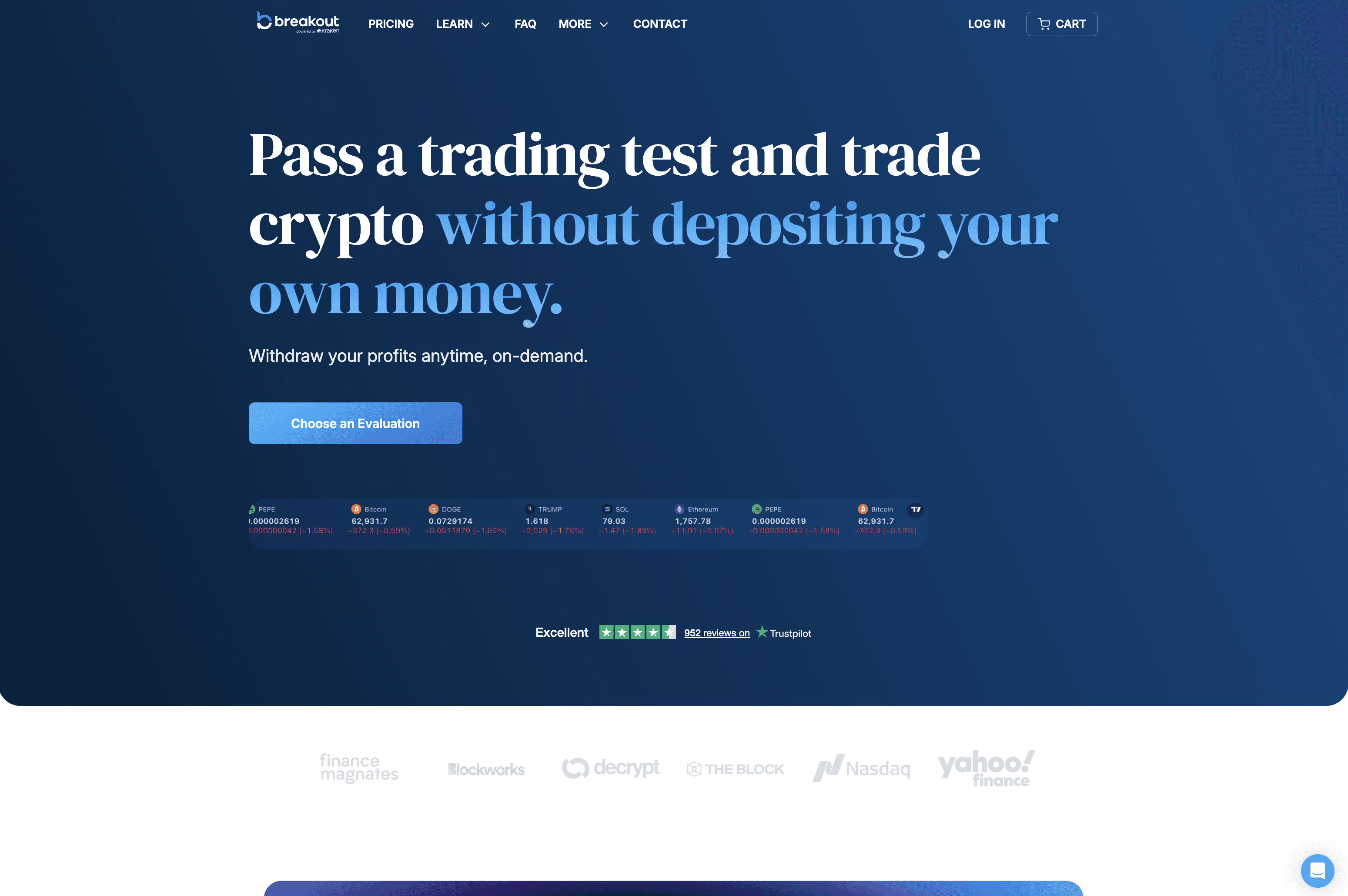
Three challenge types at each account size — Classic, Pro, and Turbo — with entry fees from $20 ($5,000 account, Turbo) up to $1,090 ($200,000 account, Pro), all one-phase evaluations
The standard split is 80/20, with a 90/10 split available as an add-on at checkout for an additional fee ($24–$54 depending on tier)
Trade-off: the higher split is an optional upgrade rather than the default offering; leverage is capped lower than some competitors
Best for: traders who value transparent, tiered pricing and are willing to pay for a higher profit split.
How Fast Do Firms Actually Pay?
Two firms publish a specific payout-speed figure directly on their own site:
AceTrader: ~1.5 days average, per its own transparency dashboard
Propr: ~5 hours average, stated on its homepage
For FTMO and Breakout, no specific payout-speed figure appears on an official pricing, rules, or FAQ page — only in third-party reviews or customer testimonials, which aren't treated as confirmed here. Traders for whom payout speed is a priority should confirm current figures directly with each firm.
Which Firm Fits You Best
Lowest entry cost: AceTrader ($9/mo for a $1,000 account)
Largest fund size range: Breakout ($200,000)
No daily loss limit: AceTrader (only max drawdown applies)
Highest leverage: AceTrader (up to 40x)
Highest possible profit split: AceTrader and FTMO (90%)
Longest operating history: FTMO
Independently verifiable payout data: AceTrader and Propr
Final Verdict
For traders who prioritize transparency and a lower upfront cost, AceTrader's combination of a public, on-chain transparency dashboard and a $9 entry point is a reasonable starting point. Current plans can be compared on the pricing page, or start a free trial to try it out.
Frequently Asked Questions
Are crypto prop firms regulated?
No — all four firms discussed here operate evaluations on simulated or demo capital and are not licensed brokers or financial institutions. Reviewing a firm's terms of service before paying any fee is advisable.
What's the difference between an evaluation and instant funding?
An evaluation requires meeting a profit target within defined risk limits before an account is funded. Instant funding bypasses that step for a higher one-time fee. AceTrader offers both, starting at $9 (evaluation) or $49 (instant fund).
Is a higher profit split always better?
Not necessarily. A 95% split from a firm with slow or unverified payouts may be worth less in practice than an 80% split from a firm with fast, consistent payouts — which is why reviewing actual payout data is often more informative than comparing headline splits alone.
Why do profit splits vary so much between firms?
Some firms offer a higher split as a paid upgrade (Breakout's 90/10 option), while others provide a flat split from day one (Propr) or tie a higher split to a specific payment method (AceTrader's split scales with the MEME-token payment tier).
What's the difference between daily drawdown and max drawdown, and how should it be evaluated?
Daily drawdown limits how much an account can lose within a single trading day, typically reset every 24 hours. Max drawdown limits the total loss allowed across the life of the account or evaluation, measured from either the starting balance or the highest equity reached.
Both exist to manage risk, but they constrain trading differently: a daily limit can end an account over one bad session even if the overall balance is still healthy, while a max drawdown only tracks cumulative performance over time.
AceTrader is the only firm in this comparison that applies a max drawdown without a separate daily loss limit, which gives traders more flexibility to manage a difficult day without an automatic cutoff, as long as the overall account stays within its limit.
How can payout claims be verified?
Look for firms that publish transaction-level data that can be checked independently. AceTrader's transparency dashboard, for example, lists individual payouts with wallet addresses and block-explorer links, allowing figures to be confirmed directly rather than relying on testimonials.
This comparison is based on publicly available information from each firm's website as of mid-2026. Prop trading involves financial risk, and rules and pricing are subject to change — current terms should be confirmed directly with each firm before signing up. This article is not financial advice.